
Introduction
The 2026 ACC/AHA dyslipidemia guidelines have done something historic. They have officially recommended that every adult be tested for lipoprotein(a) at least once. They have endorsed ApoB testing for higher-risk patients. They have expanded the role of coronary artery calcium scoring.
This is progress. The medical establishment is finally acknowledging what many of us have known for years: the standard cholesterol panel is incomplete. LDL alone does not tell the full story. Lp(a) and ApoB are essential pieces of the puzzle.
But there is a problem.
The guidelines tell doctors to test. They do not tell patients what to do if the results are abnormal—beyond taking statins and waiting for new drugs.
If you are one of the millions of people who will soon be told their Lp(a) or ApoB is high, you need more than a guideline. You need a complete guide. A guide that explains what these particles are, why your body produces them, and how to address them at their root cause.
That guide is my book, Reverse Heart Disease: No Lifelong Suffering. And this article will show you why it is the only resource that truly answers the question: “What do I do now?”
The Gap the Guidelines Left Unfilled
The 2026 cholesterol guidelines are a diagnostic document. They tell doctors whom to test, what thresholds define risk, and which drug therapies to consider . They are excellent at this.
But they contain an honest admission that reveals the gap:
“Lifestyle changes minimally affect Lp(a) levels.”
“No therapies are currently approved solely for lowering Lp(a).”
Translation: we know Lp(a) is dangerous. We know you should test for it. But beyond aggressive LDL lowering with statins and possibly PCSK9 inhibitors, we have little to offer.
For a patient just diagnosed with high Lp(a), this feels like a dead end. You are told you have a serious risk factor. You are told it is largely genetic. And then you are told there is no approved treatment specifically for it.
This is where most patients begin their desperate search for alternatives. This is where they find articles, forums, videos—and, I hope, my book.
Why Existing Advice Is Incomplete
If you search for “how to lower Lp(a) naturally,” you will find scattered information. Some sources recommend niacin, which has mixed evidence and significant side effects. Others suggest a Mediterranean diet. A few mention vitamin C or lysine.
None of these sources explain the fundamental biochemistry: Why does your body produce Lp(a) in the first place?
Without this understanding, any attempt to lower Lp(a) is guesswork. You are treating a number without understanding its origin.
My book provides the missing framework. It explains:
- Lp(a) is not a metabolic error. It is a repair particle produced by your liver.
- It is deployed when your artery walls are weak—specifically, when the collagen structure of your arteries is compromised due to long-term vitamin C deficiency.
- A 1990 US patent proved that the primary component of arterial plaque is Lp(a), not ordinary LDL. The body is literally patching cracks in your arteries with Lp(a).
- If you strengthen the artery wall by providing the nutrients collagen needs—vitamin C, lysine, and proline—the cracks heal. The need for Lp(a) patches diminishes. Lp(a) levels can normalize naturally.
This is not a supplement regimen you read about on a blog. It is a coherent, evidence-based protocol derived from decades of biochemical research—and verified by my own personal experience.
What Makes This Book Different From Every Other Guide
Most heart disease books fall into one of two categories:
Category 1: The Diet Books
These tell you to eliminate saturated fat, avoid oil, and eat only plants. They focus on what to remove. They rarely mention Lp(a). They never explain why your artery wall weakens in the first place.
Category 2: The Pharmaceutical Guides
These explain statins, PCSK9 inhibitors, and the drug pipeline. They treat Lp(a) as a target to be lowered by medication. They do not ask why the target is elevated.
My book is in a category of its own. It asks the question no one else asks: What is your body trying to do?
When you understand that Lp(a) is a repair particle, everything changes. The goal is not to suppress it with drugs. The goal is to strengthen your arteries so your body no longer needs to produce so much of it.
This is the root-cause approach. It is the difference between managing a disease and reversing it.
What You Will Learn in the Book
| Section | What It Covers |
| The True Cause of Heart Disease | Why the cholesterol hypothesis is incomplete, and what actually makes arteries fail. |
| The Lp(a) Discovery | The 1990 patent, the vitamin C connection, and the animal experiments that proved the theory. |
| The ApoB–Lp(a) Relationship | What ApoB measures, how it relates to Lp(a), and why both matter. |
| The Nutrient Protocol | Vitamin C, lysine, proline, and their supporting co-factors—how they repair the artery wall. |
| The Essential Nutrient Diet | What to eat to supply your arteries with everything they need. For vegetarians and non-vegetarians. |
| How to Track Your Progress | Which tests to re, when, and what changes to expect. |
| My Personal Story | How I went from two 80% blockages and a bypass recommendation to medicine-free at 75. |
Who Needs This Guide
- You were just told your Lp(a) is high and you are searching for answers.
- Your doctor mentioned ApoB and you do not know what it means.
- You are taking statins but your Lp(a) has not improved.
- You have a family history of early heart attacks and want to understand your real risk.
- You are a healthcare professional seeking a deeper understanding of Lp(a) and root-cause medicine.
The Only Guide That Answers “What Now?”
The 2026 guidelines have done their job. They have identified the problem. Lp(a) is a causal risk factor for cardiovascular disease. ApoB is a superior marker of atherogenic particle burden. Testing should be universal.
But a guideline is not a guide. A guideline tells your doctor what to order. It does not sit with you at your kitchen table and explain what the results mean for your life.
My book does that. It is written for the person who has just been told their numbers are abnormal and is searching, urgently, for a real solution.
You are not powerless against high Lp(a). You are not trapped by your genetics. There is a way to understand what your body is doing—and to support it in returning to health.
The guidelines tell you to test. My book tells you what to do next.
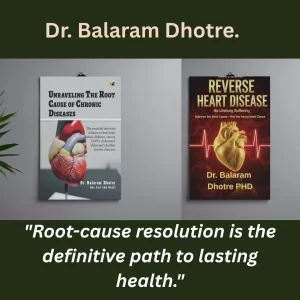
Written by Dr. Balaram Dhotre, PhD — Medicinal Chemistry (CDRI, Lucknow), with research experience across several pharmaceutical companies in India. His work focuses on explaining the nutrients the body requires, how the body uses them to function optimally, and how their deficiencies are related to chronic diseases. He is the Founder of Lypro-C and author of Unraveling The Root Cause of Chronic Diseases and Reverse Heart Disease: No Lifelong Suffering.
[Click here to get your copy of Reverse Heart Disease: No Lifelong Suffering on Amazon]
——————————————————————————————————————————–
My Books
Links on Amazon
Unraveling The Root Cause of Chronic Diseases:
Reverse Heart Disease: No Lifelong Suffering
————————————————————————————————————————-