
Lowering Lp(a) vs. Normalizing
The Most Misunderstood Concept in Cholesterol and Lipoprotein(a) Management
Lowering Lp(a) vs. Normalizing: The Most Misunderstood Concept in Cholesterol and Lipoprotein(a) Management
As a medicinal chemist and author of Reverse Heart Disease, I review hundreds of LDL and Lp(a) lowering studies.
In healthy people, the liver produces normal cholesterol levels, including the genetic risk factor Lp(a) (discovered back in 1963, not new). When arterial health starts to decline, the lipid panel gets unbalanced – LDL and Lp(a) often rise, HDL sometimes falls, and triglycerides can go up.
The Root Cause of High LDL, Lp(a), and ApoB
The critical first stage in heart disease is localized artery damage caused by chronic nutrient deficiency. This structural vulnerability triggers the liver to manufacture higher levels of sticky lipoproteins as an emergency repair mechanism. Specifically, high LDL and Lp(a) levels act as biological “band-aids,” binding directly to the microscopic lesions formed in the arteries to keep the blood vessel wall from rupturing.
The single biggest clinical error I see today is the absolute assumption that “lowering” Lp(a) numbers by 20% to 30% using aggressive pharmaceuticals—like PCSK9 inhibitors or statins—solves the systemic issue. It does not. It merely slows down the lab numbers temporarily. Without addressing the foundational matrix failure, the underlying disease continues to progress, and patients remain trapped on lifelong medication facing repeat cardiac events.
In my view, the liver should be regulating normal lipid levels on its own. But it will only do that when you completely repair the artery wall. Fix the structural integrity of the wall, and the liver calms down. The numbers take care of themselves.
If you want to prevent lifelong suffering from cardiovascular issues, you cannot just force a lab number down. You must fix the artery from the inside out.
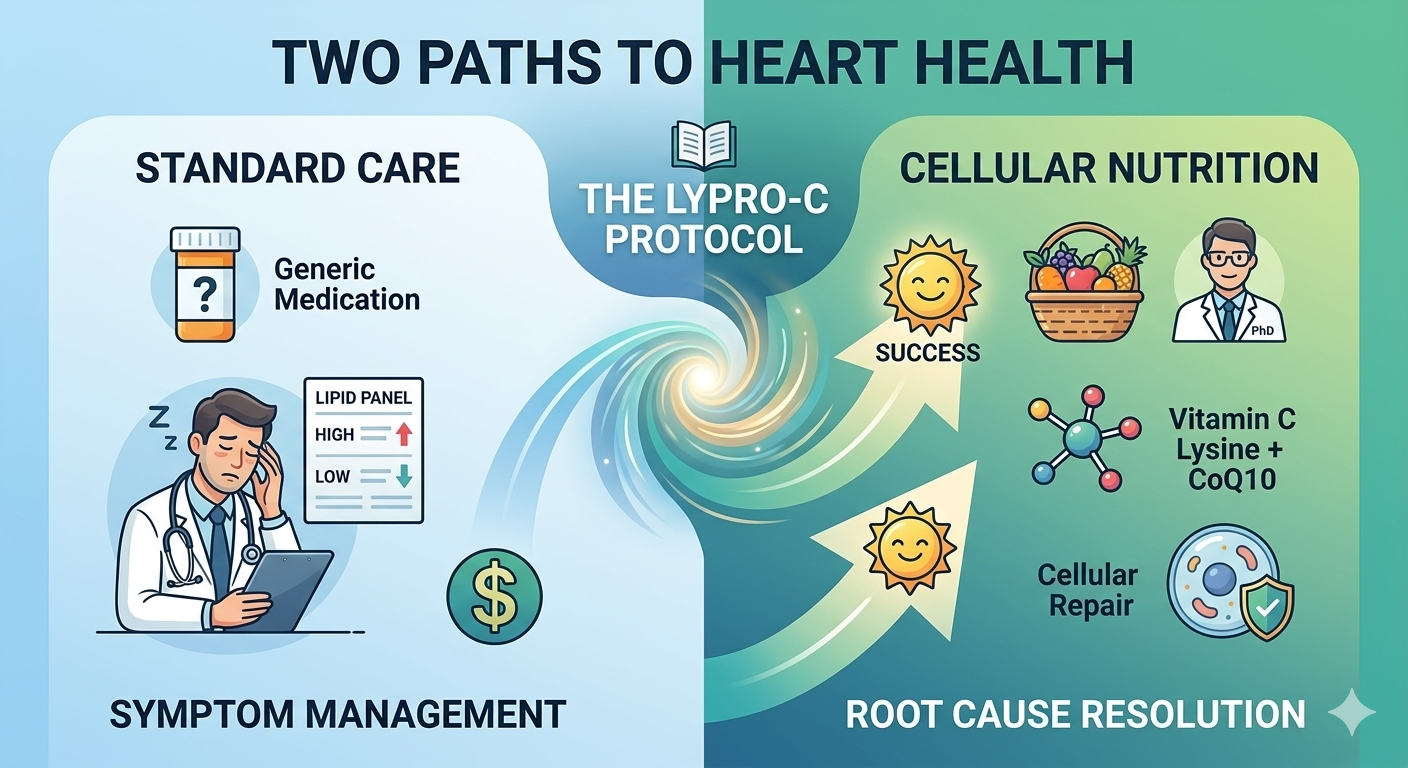
The "Lowering" Approach vs. The "Fix the Artery" Approach
The chart below outlines the critical distinction between simply lowering a particle count and executing true, root-cause arterial repair. The conventional drug approach focuses exclusively on reducing the particle count, leaving the artery wall inherently weak.
The alternative is a nutrient-based cellular nutrition protocol—restoring vital structural elements like Vitamin C, L-lysine, and L-proline to naturally rebuild the body’s collagen matrix.
| ❌ The "Lowering" Approach (Common) | ✅ The "Fix the Artery" Approach (Root Cause) |
|---|---|
| Focus: Reduce Lp(a) number by 20-30% | Focus: Strengthen artery wall with vitamin C, lysine, proline |
| Uses PCSK9 inhibitors, statins, antisense drugs | Uses nutrients that restore collagen synthesis |
| Artery remains weak – Lp(a) still patches damage | Artery becomes strong – less need for Lp(a) to patch |
| Lowers lab numbers, but disease often progresses slowly | Addresses root cause: vitamin C deficiency + matrix failure |
| Patients stay on lifelong medication | Goal is arterial repair and reduced dependency on drugs |
Bottom line: Lowering a number is not the same as fixing the artery. The left column is standard care. The right column is what I teach in Reverse Heart Disease and on this blog.
Rebuilding Collagen to Restore Cellular Balance
The standard drug approach focuses on forcing down the particle count. While that may look good on a lab report, your artery wall remains structurally compromised. Why? Because the actual root cause—a long-term, low-grade Vitamin C shortage—was never corrected.
Your cardiovascular system cannot synthesize strong, resilient collagen strands without adequate Vitamin C. As long as that deficiency exists, the artery will continue to experience microscopic tears, and the liver will keep pumping out Lp(a) to patch the vulnerabilities.
The “repair first” approach gives the blood vessels what they actually require to heal: Vitamin C, lysine, and proline. By supplying these specific cellular components, the arterial wall grows strong and firm. Lp(a) naturally becomes less dangerous because the body no longer requires an emergency patching mechanism. This isn’t artificial lowering—this is normalizing the entire cardiovascular system.
This protocol is not alternative medicine. It is firmly rooted in the groundbreaking 1990s medical research of Dr. Matthias Rath and Dr. Linus Pauling, reinforced by modern clinical observations regarding lysine, proline, and Vitamin C combinations. By assisting the artery wall in self-repair, you alter the biological conditions that make high Lp(a) dangerous in the first place, removing the need to forcefully override your numbers with drugs.
For the comprehensive, science-backed cellular nutrition protocol and full scientific references, please read my book: Reverse Heart Disease.
Have individual questions about implementing this protocol? Reach out directly via my Contact Page.
page.
For writers, bloggers, and health professionals
You have permission to use the infographic above in your own article, podcast show notes, or social media post – under one condition: you must link back to this page (lyproc.com/lp-a-lowering-vs-normalizing/) as the source. That way your readers can get the full explanation and references.
Here is the embed code you can copy and paste into your own site:
<!– Embed Code for “Lowering vs. Normalizing Lp(a)” Infographic –><figure style=”max-width:600px; margin: 20px auto;”> <img src=”https://lyproc.com/wp-content/uploads/2026/05/Gemini_Generated_Image_84c76m84c76m84c7.png” alt=”Lowering vs Normalizing Lp(a) comparison chart by Dr. Dhotre” style=”width:100%; height:auto;”> <figcaption>Source: <a href=”https://lyproc.com/lp-a-lowering-vs-normalizing/”>Dr. Balaram Dhotre, PhD – Reverse Heart Disease</a></figcaption></figure>
For Researchers or Students – Cite This Article:
Dhotre, B. Lowering Lp(a) vs. Fixing the Real Problem. Retrieved from https://lyproc.com/lp-a-lowering-vs-normalizing/
That is it. No hidden agenda. My primary goal is to help individuals understand the profound operational difference between covering up a symptom and restoring systemic cellular health.
Recommended Reading: For targeted nutritional support designed to repair the arteries and help the liver produce normal lipid levels, see this article: Lp(a) & LDL Reduction Supplement.
My Books
