
Why Micronutrient Deficiency Destroys Cellular Function
You have been told a story about heart disease for decades, trying to convince you that it is the root cause of heart disease.
The story goes like this: heart disease is caused by high cholesterol. High cholesterol comes from eating saturated fat. The solution is to cut out saturated fat, take statins, and follow a strict plant‑based diet. Follow this plan, and you will manage your condition. You will manage it for the rest of your life.
Does this story sound familiar?
Now look at the people who believed that story. My friend Mahesh followed it faithfully. He took the drugs. He even allowed four stents to be placed in his arteries—a painful, invasive, and expensive procedure. Yet his disease progressed. He now lives in fear of amputation and dialysis. Another friend, Nilesh, started taking medicines at age 23. Today, at 45, he swallows 22 different pills every single day. He has diabetes, heart disease, and even Alzheimer’s. Despite early diagnosis and strict compliance, his body collapsed.
The management plan did not heal them. It only managed their decline.
What if the story itself is wrong?
I am Dr. Balaram Dhotre. I am a researcher, trained in drug design at the Central Drug Research Institute. My own heart disease crisis in 2010 forced me to look outside the conventional model. What I discovered changed my life and has since changed the lives of many others. The truth is simple, yet it remains hidden from most patients: **heart disease has a real root cause, and it has nothing to do with cholesterol or saturated fat.** It has everything to do with your cells and the nutrients they need to function.
Once you understand this, you will see why lifelong suffering is not a necessity. It is a choice—and you can choose differently.
The Two Kinds of Causes: Associated and Real
Before we go further, you must understand one of the most important concepts in medicine—a concept that most doctors never explain to you.
When you ask your doctor what causes heart disease, the answer you receive is a list of **risk factors**: high cholesterol, high blood pressure, smoking, obesity, poor diet, lack of exercise. These are not causes. They are associations. They are things that are observed more often in people with the disease. An *associated cause* is not a *root cause*.
Here is an example from everyday life. Suppose your car stops working. What is the reason? If you think like conventional medicine, you would say the risk factors are: driving too fast, driving on rough roads, or talking on a mobile phone while driving. These are associated with car breakdowns. But are they the real reason? No. The real reason could be a dead battery, a flat tyre, or no petrol. These are the actual causes of the dysfunction. If you fix the battery, the car runs. The risk factors only increase the chance of something going wrong; they are not the thing that went wrong itself.
Our body is a biological machine. When it is diseased, it means some part of it is not functioning properly. The root cause of that dysfunction must be something that directly impairs the function of your cells—the tiny living units that make up your heart, your blood vessels, and every other organ.
What impairs cellular function? Something that is missing. Something your cells need to work but are not receiving.
The Real Root Cause: Your Cells Are Starving for Essential Nutrients
Every cell in your body performs thousands of chemical reactions every second. Your heart muscle cells need enormous amounts of energy to pump blood continuously. Your artery wall cells need to repair themselves constantly—the entire heart is reconstructed with brand‑new protein components every 30 days. For this, cells require two types of nutrients:
- Nutrients that get transformed – the fuel and building blocks. These are glucose, fatty acids, and amino acids obtained from carbohydrates, fats, and proteins.
- Nutrients that help bring about the transformation – the catalysts. These are vitamins, minerals, and other micronutrients. They are the spark plugs, the ignition, the workers that enable the transformation to happen.
Think of burning coal. Coal is the bulk material that gets transformed into energy. But coal cannot ignite on its own. You need oxygen and a small initial fire—the spark. Without the spark, the coal is just a black rock.
Now think of constructing a building. Bricks, cement, and steel rods are the bulk raw materials. But dump them on a plot of land and wait. Will a building construct itself? No. You need masons, tools, water, and energy. The raw materials are the ones that get transformed; the workers are the ones who bring about the transformation.
In your body, vitamins and minerals are the workers. Without them, glucose cannot be converted into energy, amino acids cannot be assembled into collagen, and fatty acids cannot be utilised properly.
Here is the fatal connection: **A poor diet—especially one low in fruits and vegetables—is deficient in these micronutrients.** If you keep eating food from which the micronutrients have been removed (like sugar, refined flour, polished rice, processed foods), you are giving your cells the fuel but not the spark plugs. Over months and years, your cells become unable to perform their functions. They malfunction. They become diseased.
This is the root cause of chronic disease: **a deficiency of essential nutrients impairs cellular function.** Not cholesterol. Not saturated fat. Not even the absence of plant foods alone—but the absence of the specific nutrients your cells need to work.
What Does This Mean for Heart Disease?
Heart disease is not a cholesterol storage problem. It is a structural failure of the artery wall.
Your arteries are living tissues. They are made of collagen, a tough, flexible protein that gives the vessel its strength and integrity. Collagen, like all proteins, requires specific amino acids as building blocks—especially **lysine** and **proline**. More importantly, the production of strong collagen depends absolutely on **vitamin C**. Without adequate vitamin C, the body cannot form or repair collagen properly.
When vitamin C is deficient over a long period, the endothelial lining of the arteries becomes fragile. Tiny cracks and lesions develop. This is where the trouble begins.
The body, in its wisdom, tries to patch these cracks. But instead of healthy collagen, it uses a sticky repair material made from lipoprotein(a)—a special form of cholesterol that acts like a biological band‑aid. Over time, layer upon layer of this repair material builds up. This is what we call an arterial plaque.
You see, the cholesterol plaque is not the cause of the disease; it is the body’s response to an underlying structural weakness caused by vitamin C deficiency. The real root cause is the lack of collagen‑building nutrients that keeps the artery wall strong in the first place.
This is why the statin‑lowering, fat‑avoiding, plant‑only approach never truly reverses heart disease. It addresses the *associated cause*—the presence of cholesterol—but it never corrects the *true cause*: the micronutrient deficiency that made the arteries fragile. It is like painting over a crack in a wall that is crumbling from within. The wall will continue to fall.
Why a Strict Plant‑Based Diet Alone May Fall Short
I want to be clear: eating more vegetables and fruits is a necessary step. They are rich sources of many vitamins and minerals. But a diet that eliminates all animal foods, simply because saturated fat is considered harmful, can become a problem of its own kind.
Lysine and proline are amino acids found in high concentrations in animal foods like eggs, dairy, fish, and meat. While plants also contain some amino acids, a diet that completely excludes animal sources may struggle to supply the quantities needed for robust arterial repair—especially in a person already suffering from long‑standing deficiencies.
The true solution is not about being a vegan or a non‑vegetarian. It is about ensuring your cells receive the *essential nutrients* they require, whether those nutrients come from plants, animals, or both. The goal is cellular repair, not dietary purity.
Conventional advice tells you to avoid oil, avoid fat, avoid meat, and eat only plants. This may temporarily reduce some risk factors, but it does not actively rebuild the artery wall. Only the right nutrients—vitamin C, lysine, proline, and the many cofactor vitamins and minerals that support their function—can accomplish true healing.
The Root‑Cause Solution: Give Your Cells What They Need
If micronutrient deficiency is the root cause, then the solution is straightforward: **Provide all essential nutrients in adequate amounts, and your cells will start functioning again.** Your body has a powerful, innate ability to heal itself when you give it the right tools.
Here is what a root‑cause protocol for heart disease must include:
– Vitamin C – the master collagen builder and antioxidant that protects and repairs the endothelium.
– Lysine – an essential amino acid that forms the structural backbone of collagen and can also bind lipoprotein(a), helping to prevent further plaque deposition.
– Proline – another key amino acid for collagen stability and vessel repair.
– **A full spectrum of B‑complex vitamins, magnesium, zinc, copper, and other cofactors** – because all cellular functions require multiple nutrients working in synergy, like workers building a house.
These nutrients are not foreign drugs. They are the same substances your body has used since birth to grow, repair, and maintain itself.
My personal journey is proof. In 2010, I had two blockages above 80%. An angioplasty was done on one side, but I refused bypass surgery. Instead, I researched and formulated a supplement based on these very principles—what I later called the Lypro‑C formula. I took it regularly. Today, at 75, I am hale and hearty, medicine‑free, and my heart functions well.
I did not heal because I eliminated a risk factor. I healed because I addressed the root cause: I gave my cells the micronutrients they had been missing.
What You Must Do Now
You have been living under a false narrative. You have been told that heart disease is a lifelong, incurable condition that can only be managed with drugs and dietary restriction. This is not true.
The real root cause of heart disease is a deficiency of essential nutrients that impairs cellular function and prevents the artery wall from repairing itself. When you correct that deficiency, you give your body the raw materials it needs to restore health from the inside out.
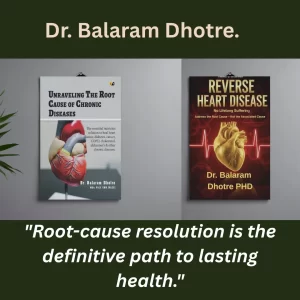
I have written two books to guide you through this new understanding. *Unravelling the Root Cause of Chronic Diseases* lays out the complete scientific foundation—the step‑by‑step logic that proves why micronutrient deficiency is the single underlying driver of all chronic illness. *Reverse Heart Disease: No Lifelong Suffering* is the practical application, showing you exactly which nutrients, which foods, and which daily habits will liberate you from a lifetime of pills.
Start by learning the difference between an associated cause and a true cause. Start questioning whether your current treatment is providing the essential nutrients your cells need. Start giving your body the building blocks of repair.
The power to end lifelong suffering is not in your doctor’s prescription pad. It is in your own hands—and on your own plate.
“Your cells know how to heal. Give them what they need, and they will.”
======================================================================
About Author
Written by Dr. Balaram Dhotre, PhD — Medicinal Chemistry (CDRI, Lucknow), with research experience across several pharmaceutical companies in India. His work focuses on explaining the nutrients the body requires, how the body uses them to function optimally, and how their deficiencies are related to chronic diseases. He is the Founder of Lypro-C and author of Unraveling The Root Cause of Chronic Diseases and Reverse Heart Disease: No Lifelong Suffering.
Click here to get your copy of:::::Reverse Heart Disease: No Lifelong Suffering on Amazon
=========================================================================
My Books
============================================================================
Links to books: