
Why True Heart Disease Reversal Must Repair the Artery Wall
In the world of heart disease treatment, there is a word you will hear often: endothelium.
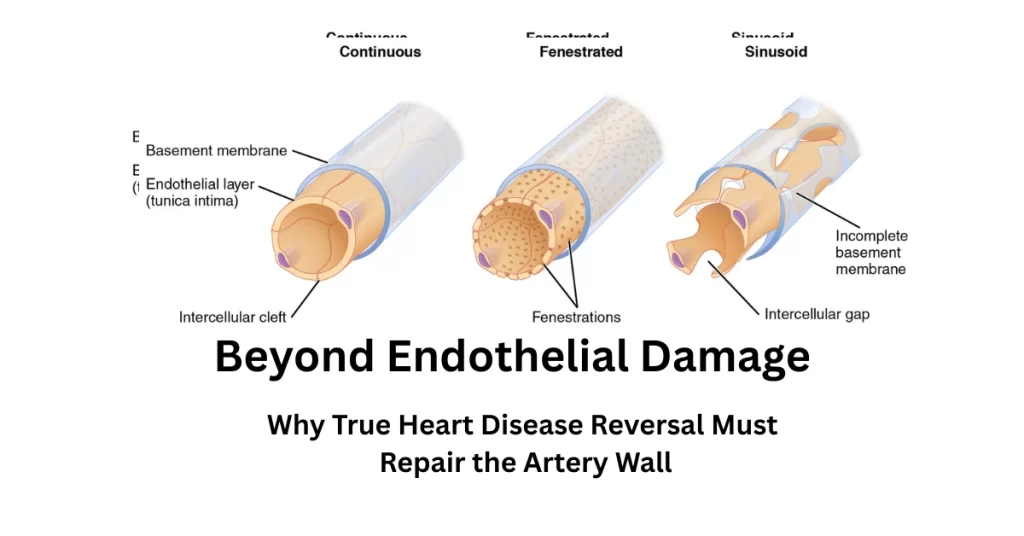
The endothelium is the thin layer of cells that lines the inside of your blood vessels. It is delicate, biologically active, and essential for vascular health. When it is functioning well, it produces nitric oxide, keeps blood flowing smoothly, and prevents unwanted clotting. When it is damaged—by oxidative stress, high blood pressure, smoking, or poor diet—the stage is set for disease.
Conventional medicine and even many nutritional approaches have made endothelial protection their central goal. The logic is straightforward: if you can stop injuring the endothelium, you can stop the disease. Avoid oils that cause oxidative stress. Avoid saturated fats that are said to raise cholesterol. Eat antioxidant‑rich plants that protect the lining. Exercise to improve blood flow.
This is all valuable. Protecting the endothelium is a necessary part of any heart disease strategy. But there is a problem that almost no one talks about.
Protecting the endothelium is not the same as repairing the artery wall. And true reversal demands repair.
If you have been following a strict diet, avoiding every food you were told to avoid, and still wondering why your condition does not truly improve, this article is for you. I am going to explain the difference between endothelial protection and structural repair—and why that difference is the line between managing disease and reversing it.
The Two Layers of the Artery: What Most Advice Ignores
Your arteries are not simple pipes. They are complex, living structures with multiple layers. Understanding these layers is essential to understanding why some approaches work and others fall short.
The endothelium is the innermost layer. It is just one cell thick. Think of it as the wallpaper lining the inside of a room. It is delicate, and it is the first thing to show damage when the environment becomes hostile. When the endothelium is injured—by oxidative stress, inflammation, or nutrient deficiency—it loses its ability to produce nitric oxide. Blood vessels constrict instead of relaxing. The lining becomes sticky, attracting particles that should flow past. In short, we can say that the endothelial function is affected.
Protecting the endothelium means reducing the sources of injury: removing processed oils, quitting smoking, controlling blood sugar, eating antioxidant‑rich foods. This is good. It is necessary. But it is not sufficient.
The media is the middle layer, and it is the structural heart of the artery. It is made of smooth muscle cells and a dense matrix of collagen and elastin fibres. This layer gives the artery its strength and flexibility. It withstands the constant pressure of blood flow, expanding and contracting with every heartbeat. When this layer is weak, the artery is prone to cracking and bulging. When it is strong, the artery can handle the mechanical stress of daily life.
The adventitia is the outer layer, providing additional structural support and housing small blood vessels that nourish the artery wall itself.
Here is the critical point: most heart disease strategies focus almost entirely on the endothelium—the innermost wallpaper. They aim to prevent further injury to this lining. But the real structural damage, the weakness that leads to plaque formation in the first place, often lies deeper—in the collagen matrix of the media.
If you protect the wallpaper but never repair the cracks in the wall behind it, the wall remains weak. Eventually, the wallpaper will crack again.
How Plaque Really Forms: The Sequence Most People Don’t Understand
The conventional story says that cholesterol builds up on the artery wall like grease in a pipe. This is wrong.
The true sequence, based on decades of biochemical research, is as follows:
- Micronutrient deficiency develops over years. A diet low in fruits, vegetables, and quality protein leads to inadequate levels of vitamin C, lysine, proline, and their supporting co‑factors.
- Collagen synthesis is impaired. Without adequate vitamin C, the enzymes that build and maintain collagen cannot function. The collagen matrix in the artery wall—the media—becomes weak and brittle.
- Micro‑cracks appear. The artery, subjected to the constant mechanical stress of blood flow, develops tiny fissures in the weakened collagen. These are not visible to the naked eye, but they are real.
- The body responds with an emergency repair. The liver produces lipoprotein(a), a sticky cholesterol‑based particle designed to patch the cracks. Lipoprotein(a) is not a villain. It is a biological band‑aid, deployed when the proper building materials are absent.
- Plaque accumulates. Over years, layer upon layer of these emergency patches builds up. This is what we call arterial plaque. It is not a deposit of dietary fat. It is a scar—a sign that the body has been trying to repair a structural weakness using the only materials it had available.
In this sequence, the endothelial damage is real, but it is often secondary to the underlying collagen weakness. The endothelium cracks because the wall behind it is failing. Protecting the endothelium without repairing the wall is like painting over a crack in plaster without fixing the underlying structural issue. It looks better for a while, but the crack returns.
Why Endothelial Protection Alone Cannot Reverse Disease
Endothelial protection strategies—plant‑based diets, antioxidants, avoidance of oxidative stress—can slow the rate of new injury. They may reduce the frequency of new cracks. In some cases, they can even allow the endothelium to regenerate partially, improving nitric oxide production and symptom relief.
But these strategies do not actively rebuild the collagen matrix of the media. They do not supply the specific amino acids—lysine and proline—needed to weave new, strong collagen fibres. They do not provide therapeutic doses of vitamin C to activate the collagen‑synthesising enzymes that have been dormant.
Without active rebuilding, the structural weakness persists. The artery remains vulnerable. Any future stress—a period of poor eating, an infection, a bout of high blood pressure—can reopen the cracks and restart the plaque cycle.
This is why some people who follow strict plant‑based diets still experience disease progression. They are protecting the surface but not repairing the foundation. They are doing half the job, and half the job does not produce full healing.
What True Repair Requires
True reversal demands that you go beyond endothelial protection and actively supply the nutrients that rebuild the artery wall. Here is what that means in practice:
- Restore Collagen Synthesis with Therapeutic Vitamin C
Vitamin C is the non‑negotiable foundation of arterial repair. It is the essential co‑factor for the enzymes prolyl hydroxylase and lysyl hydroxylase, which stabilise and cross‑link collagen fibres. Without vitamin C, collagen cannot form properly, no matter how much lysine and proline are present.
The amount of vitamin C needed for therapeutic repair often exceeds what diet alone can provide. Amla, guava, citrus, and bell peppers are excellent food sources. But for someone with established arterial weakness, supplementation at higher doses is often necessary. This is not about preventing scurvy. It is about reactivating a repair process that has been dormant for years.
- Supply the Structural Amino Acids: Lysine and Proline
Collagen is made of amino acids, and two of them dominate its structure. Lysine forms the cross‑links that give collagen its tensile strength. Proline stabilises the triple‑helix shape. Without these amino acids in adequate supply, the collagen matrix remains sparse and fragile.
Eggs, dairy, fish, and lean meats are the richest sources. Plant sources like legumes and quinoa can contribute, but achieving therapeutic levels from plants alone requires deliberate, consistent planning.
- Include the Full Team of Co‑Factors
Collagen synthesis does not happen in isolation. It requires:
- Magnesium for ATP stabilisation—the energy currency that powers every repair enzyme.
- Zinc for cell division and new tissue formation.
- Copper to cross‑link collagen and elastin, giving the artery its elasticity.
- B‑complex vitamins as coenzymes in every metabolic step.
A diet rich in leafy greens, nuts, seeds, whole grains, and quality protein supplies these co‑factors. If the diet is limited, targeted supplementation fills the gap.
- Be Consistent and Patient
Arterial damage took decades to develop. Meaningful repair takes months to years. But every day that you supply the right nutrients, your body moves one step closer to structural integrity. There is no shortcut, but there is a clear path.
My Own Experience: Treating the Wall, Not Just the Lining
In 2010, I had two coronary artery blockages above 80%. The conventional approach—statins, blood thinners, and a strict plant‑based diet—would have focused on protecting my remaining endothelium from further injury. That might have slowed the disease. It would not have repaired the structural weakness that caused it.
I chose a different path. I researched the biochemistry of the artery wall. I discovered the role of vitamin C in collagen synthesis and the role of lysine and proline as the structural building blocks. I learned that lipoprotein(a) is not an enemy but an emergency repair material—deployed when the wall is too weak to hold itself together.
I formulated the Lypro‑C supplement to provide therapeutic doses of vitamin C, lysine, proline, and the supporting co‑factors my arteries needed. I also ate a diet that included both plant and animal foods, chosen specifically to supply all essential nutrients.
I did not just protect my endothelium. I gave my artery wall the materials to rebuild.
Today, at 75, I am medicine‑free. My heart functions well. I did not manage my disease. I reversed its course by treating the wall, not just the lining.
How to Apply This Today
If you are ready to move beyond endothelial protection and pursue true structural repair, here are your steps:
- Assess your current strategy. Ask yourself honestly: is your current approach focused only on what you avoid, or does it actively supply what your arteries need to rebuild? Protection without provision is incomplete.
- Ensure therapeutic vitamin C intake. Food sources are the foundation. Supplementation closes the gap between dietary levels and therapeutic doses. Do not settle for the RDA. The RDA prevents scurvy. It does not reverse structural arterial damage.
- Evaluate your lysine and proline intake. Are you consuming eggs, dairy, or other rich sources? If you follow a strict plant‑based diet, are you obtaining enough of these amino acids from legumes, quinoa, and nuts? Be honest. Deficiency in these building blocks means the repair cannot proceed.
- Support the process with the full team of co‑factors. Magnesium, zinc, copper, and B‑vitamins are not optional extras. They are essential members of the repair crew.
- Read the full protocol. My book Reverse Heart Disease: No Lifelong Suffering provides the complete, step‑by‑step guide to this approach—the exact nutrients, the dosages, the dietary measures, and the rationale behind each element.
The Bottom Line
The endothelium is important. Protecting it is a necessary part of any heart disease strategy. But protection is not repair. Avoiding injury is not the same as rebuilding the wall.
True reversal requires you to go deeper—to the collagen matrix of the media, the structural heart of your arteries. It requires you to supply the specific nutrients that weave strong, elastic collagen fibres. Vitamin C to activate the builders. Lysine and proline to supply the bricks. The full team of co‑factors to power the work.
Your arteries are not lifeless pipes. They are living tissue, designed to repair and renew. They have been waiting—perhaps for years—for the raw materials they need.
Stop settling for protection alone. Give your arteries what they need to rebuild, and they will.
True heart disease reversal begins when you stop treating the surface and start repairing the wall.
Written by Dr. Balaram Dhotre, PhD — Medicinal Chemistry (CDRI, Lucknow), with research experience across several pharmaceutical companies in India. His work focuses on explaining the nutrients the body requires, how the body uses them to function optimally, and how their deficiencies are related to chronic diseases. He is the Founder of Lypro-C and author of Unraveling The Root Cause of Chronic Diseases and Reverse Heart Disease: No Lifelong Suffering.
Click here to get your copy of:::::Reverse Heart Disease: No Lifelong Suffering on Amazon
Visit lyproc.com to read more articles and learn about the root‑cause approach to chronic disease reversal.
——————————————————————————————————————————-
BOOKS BY DR BALARAM DHOTRE
Links on Amazon
Unraveling The Root Cause of Chronic Diseases:
Reverse Heart Disease: No Lifelong Suffering
————————————————————————————————————————–