

Introduction
You just got your blood test results. Your doctor looks concerned. “Your Lp(a) is high,” she says. “Unfortunately, it’s genetic. There is not much we can do about it. We will focus on lowering your LDL instead.”
You leave the clinic with a statin prescription and a sinking feeling in your chest. Something important was just dismissed. Something that could cause a heart attack or stroke. And you were told nothing can be done.
If this sounds familiar, I wrote my book for you.
My name is Dr. Balaram Dhotre. I am a PhD medicinal chemist. In 2010, I was diagnosed with two coronary artery blockages above 80%. Like you, I was told my condition was serious. Unlike most patients, I had the training to dig deeper.
What I found about lipoprotein(a)—what it really is, why your body makes it, and how to address it naturally—changed my life. Today, at 75, I take no heart medications. My arteries are clear. My heart functions well.
This article explains why my book, Reverse Heart Disease: No Lifelong Suffering, is the guide you need if your Lp(a) is high and you refuse to accept that nothing can be done.
What Your Doctor Probably Did Not Tell You About Lp(a)
Lipoprotein(a) is not a villain. It is a repair particle.
Your artery walls are made of collagen—a tough, flexible protein that requires vitamin C to form properly. When vitamin C is deficient over many years, the collagen weakens. The artery wall develops tiny, invisible cracks.
Your liver responds by producing Lp(a). Lp(a) is sticky by design. It travels to the site of the crack and deposits itself as a biological band-aid. Over decades, layer upon layer of these patches builds up. That is what we call arterial plaque.
A 1990 US patent proved this directly. Using gel electrophoresis, researchers showed that the primary component of human arterial plaque is Lp(a)—not ordinary LDL cholesterol.
Your Lp(a) is high because your artery walls are weak. The solution is not just to lower a number. The solution is to strengthen the artery wall so your body no longer needs to produce so much Lp(a) in the first place.
This is what conventional medicine misses. And it is what my book explains in full.
Why Most Advice on Lp(a) Falls Short
The standard medical response to high Lp(a) falls into three categories:
- “It is genetic. Nothing can be done.”
This is the most common response. It is also incomplete. Yes, your baseline Lp(a) level has a genetic component. But genes do not operate in a vacuum. They respond to the nutritional environment of your cells. If your artery walls are strong, your body has no reason to overproduce Lp(a). Genetics loads the gun. Nutrition pulls the trigger. - “We will manage your other risk factors instead.”
Since there is no approved drug specifically for Lp(a), doctors focus on lowering LDL with statins. But statins do not lower Lp(a). In some patients, they may even raise it slightly. You end up taking a medication that does not address the very thing that most threatens you. - “New drugs are coming.”
PCSK9 inhibitors can reduce Lp(a) by about 20–30%. Newer antisense oligonucleotides are in trials. But these drugs are expensive, come with side effects, and still do not answer the fundamental question: why is your body overproducing Lp(a) in the first place?
My book offers a different path—one that addresses the root cause rather than managing the marker.
What My Book Teaches You About Lp(a)
Reverse Heart Disease: No Lifelong Suffering is not a book about managing numbers. It is a book about restoring function. Here is what you will learn:
The Lp(a)–Vitamin C Connection
Why your arteries need vitamin C to stay strong, and how long-term deficiency leads to the cracks that trigger Lp(a) production. This is the biochemistry your doctor never explained.
The Role of Lysine and Proline
Lp(a) sticks to the artery wall through specific binding sites. Lysine can occupy those same sites, preventing Lp(a) from depositing. Meanwhile, lysine and proline together supply the building blocks for new, strong collagen. You are not just stopping the patches—you are repairing the wall.
How to Support Your Liver Naturally
Your liver produces Lp(a) in response to arterial weakness. When you provide the nutrients that strengthen your arteries, you address the signal that tells your liver to produce excess Lp(a). Over time, the need for high Lp(a) diminishes.unr
The Essential Nutrient Diet
A way of eating focused on what to include, not just what to avoid. This diet supplies vitamin C, lysine, proline, and their supporting nutrients from both plant and animal sources. It works whether you are vegetarian or non-vegetarian.
How to Monitor Your Progress
What to test, when to test, and what changes to expect. You do not have to guess whether the protocol is working. The markers will tell you.
Why I Am Qualified to Write This Book
I am not a journalist who interviewed experts. I am the expert who lived it.
Before my diagnosis, I spent years designing drugs at the Central Drug Research Institute. I understand biochemistry. I understand how the body works at the molecular level. When my own arteries failed, I did not accept the standard explanation. I researched the literature. I found the Lp(a)–vitamin C connection. I applied it to myself.
The result? I am 75 years old, medicine-free, with a functioning heart and clear arteries. I did not manage my disease. I reversed it by addressing its root cause.
This book is not a theory. It is the documented outcome of a researcher who used himself as the first subject.
Who This Book Is For
- You have been told your Lp(a) is high and nothing can be done.
- You are taking statins and wondering why your Lp(a) is not improving.
- You have a family history of early heart attacks and want to understand the real risk.
- You have had a stent or bypass and want to prevent the next one.
- You are a doctor or health professional seeking a deeper understanding of Lp(a).
What Readers Have Experienced
People who have applied the principles in this book report:
- A new understanding of why their arteries failed.
- Reduced anxiety about their Lp(a) numbers.
- Improved energy and exercise tolerance.
- Better cholesterol profiles, including HDL improvement.
- A sense of control over their health for the first time since diagnosis.
Individual results vary. But the principle is universal: when you give your cells what they need, they function better.
The Book That Finally Explains Lp(a)
You have been told that Lp(a) is a mystery. That it is genetic. That nothing can be done.
None of that is the full truth.
Lp(a) is a repair particle. It exists because your artery wall is weak. Strengthen the wall, and the need for emergency patches disappears. This is not alternative medicine. It is biochemistry.
Reverse Heart Disease: No Lifelong Suffering is the book that connects these dots. It is written for the person who has just been told their Lp(a) is high and is searching desperately for a real solution.
You do not have to accept that nothing can be done. There is a way. My book shows you how.
Written by Dr. Balaram Dhotre, PhD — Medicinal Chemistry (CDRI, Lucknow), with research experience across several pharmaceutical companies in India. His work focuses on explaining the nutrients the body requires, how the body uses them to function optimally, and how their deficiencies are related to chronic diseases. He is the Founder of Lypro-C and author of Unraveling The Root Cause of Chronic Diseases and Reverse Heart Disease: No Lifelong Suffering.
<div style=”background-color: #f4f6f9; border-left: 5px solid #0073aa; padding: 20px; margin: 30px 0; border-radius: 4px;”>
<h3 style=”margin-top: 0; color: #111;”>📕 Halt the Decline & Address the Root Cause</h3>
<p>Managing your numbers with lifelong prescriptions is only half the battle. To discover the complete cellular nutrition protocol to repair your vascular walls and stop arterial plaque at its source, secure your copy of Dr. Balaram Dhotre’s definitive guide today.</p>
📕 Halt the Decline & Address the Root Cause
Managing your numbers with lifelong prescriptions is only half the battle. To discover the complete cellular nutrition protocol to repair your vascular walls and stop arterial plaque at its source, secure your copy of Dr. Balaram Dhotre’s definitive guide today.
Get “Reverse Heart Disease: No Lifelong Suffering” on Amazon
[Click here to get your copy of Reverse Heart Disease: No Lifelong Suffering on Amazon]
——————————————————————————————————————————
My Books
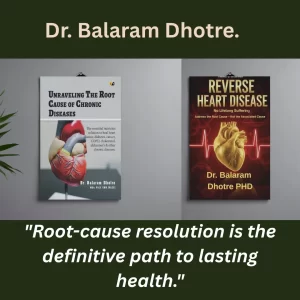
Links on Amazon
Unraveling The Root Cause of Chronic Diseases:
Reverse Heart Disease: No Lifelong Suffering
——————————————————————————————————————–