If you have been diagnosed with heart disease, you have almost certainly received a long list of foods to avoid. No oil. No saturated fat. No eggs. No meat. Stick to plants, and your arteries will supposedly clear themselves.
It sounds reasonable. Yet I meet people every day who have followed that advice to the letter and still find themselves in the cardiologist’s waiting room, still swallowing statins, still fearing the next chest pain. My friend Mahesh eliminated everything he was told to eliminate—and he still ended up with four stents and the threat of amputation.
Something is missing from the conversation. Something that even well‑meaning plant‑based advocates rarely discuss.
What is missing is not another food to cut out. What is missing are three specific nutrients your arteries need to repair themselves—nutrients that many popular heart disease diets fail to supply in adequate amounts. When those nutrients are absent, the artery wall remains weak, no matter how pure your diet looks on paper.
Those three nutrients are vitamin C, lysine, and proline. If you have never heard them discussed in the context of heart disease, this article may change the way you think about healing forever.
Healing Is Not the Same as Avoiding
Before I introduce the three nutrients, you must understand a simple truth: there is a world of difference between protecting an artery from injury and actively rebuilding it.
A doctor who tells you to avoid oil is trying to reduce the ongoing chemical stress on your endothelium—the delicate inner lining of your blood vessels. That is a protective measure. It may slow down the damage. But it does nothing to repair the structural cracks that are already there.
Imagine you own a house with a cracked foundation. You can stop parking heavy vehicles near the house so the cracks do not get worse. That is the avoidance strategy. But if you never mix cement and fill the cracks, the foundation remains broken. The next tremor, the next storm, and the house continues to crumble.
Your arteries are the same. The endothelial lining and the collagen scaffolding beneath it have been damaged by years of micronutrient deficiency. Avoiding oil does not supply the building blocks to rebuild that scaffolding. For true reversal, you must actively provide the nutrients that make up the arterial wall.
And the three most important of those nutrients—the ones that are most commonly missing—are vitamin C, lysine, and proline.
Vitamin C: The Master Builder Your Arteries Cannot Do Without
Every blood vessel in your body is held together by a protein called collagen. Collagen is the steel frame of your arteries. It gives them the strength to withstand the constant pressure of blood flow, and the flexibility to expand and contract with every heartbeat.
Collagen cannot be made without vitamin C. It is as simple as that.
Vitamin C is the essential co‑factor for the enzymes that knit amino acids into the strong, triple‑helix strands of collagen. When vitamin C is deficient—even slightly, but over a long period—the collagen matrix becomes weak. Tiny, invisible cracks develop in the endothelial lining. The body senses these cracks as injuries and rushes to patch them with a sticky, cholesterol‑based material called lipoprotein(a). Layer upon layer of these emergency patches form what we call an arterial plaque.
Notice the sequence: the plaque did not arrive because you ate fat. It arrived because the artery wall was failing from a lack of vitamin C. The cholesterol patch is not the enemy; it is a desperate, last‑resort repair material deployed by a body that has run out of proper building blocks.
The solution is not to eliminate cholesterol with statins. The solution is to restore vitamin C so the artery can build strong, healthy collagen once again.
Rich food sources of vitamin C include amla (Indian gooseberry), guava, citrus fruits, bell peppers, and leafy greens. However, therapeutic reversal often requires amounts beyond what a normal diet can provide. This is why supplementation with high‑quality vitamin C is a cornerstone of any serious heart disease reversal protocol.
Lysine: The Amino Acid That Strengthens and Protects
If vitamin C is the builder that activates the construction crew, lysine is one of the actual bricks in the collagen wall.
Lysine is an essential amino acid, meaning the body cannot manufacture it. It must come from food or supplementation. In collagen, lysine forms the cross‑links that connect individual protein strands together, giving the structure its remarkable tensile strength. Without sufficient lysine, the collagen scaffolding remains loose and fragile, like a scaffold assembled with missing bolts.
But lysine has a second, equally extraordinary function. The lipoprotein(a) particles that rush to patch arterial cracks attach to the vessel wall through specific binding sites. Lysine can occupy those same binding sites, acting as a natural shield that blocks further lipoprotein(a) deposition. In plain language, lysine not only helps build a stronger artery—it also helps stop new plaque from forming while the repair takes place.
Now consider this: the strict plant‑based, oil‑free diets often recommended for heart disease can be quite low in lysine. The richest sources of lysine—eggs, dairy, fish, and meat—are precisely the foods that conventional advice tells you to avoid. A person who follows that advice perfectly may end up with chronically low lysine intake, never understanding why their condition continues to worsen despite their dietary discipline.
This is not an argument against plants. It is an argument against nutritional deficiency. The goal is to provide the lysine your arteries demand, from whatever high‑quality source you choose.
Proline: The Overlooked Partner in Collagen Stability
Proline is the second major amino acid in collagen, working alongside lysine to give the protein its unique, stable shape. Together, lysine and proline make up a large proportion of the collagen molecule. Without proline, the triple helix cannot hold its form.
Proline is not classified as an essential amino acid in healthy adults because the body can produce some of it. But during periods of active tissue repair—which is exactly what heart disease reversal demands—the body’s own production may fall short. Healing a damaged artery wall requires a substantial supply of proline, far above the maintenance level.
Just like lysine, proline is found in concentrated amounts in animal foods such as eggs and dairy, as well as in bone broths. Plant foods contain some proline precursors, but again, the therapeutic need may exceed what a restrictive diet can deliver.
When vitamin C, lysine, and proline are all present in adequate quantities, the artery has everything it needs to weave a strong, new collagen matrix. The cracks begin to fill—not with sticky cholesterol patches, but with healthy, elastic tissue. This is true healing.
The Synergy Principle: No Nutrient Works Alone
I must emphasise one more point, because it is often overlooked even by people who understand the importance of these three nutrients.
Your body never uses a single nutrient in isolation. Every biological process requires multiple nutrients working together, like a team of workers constructing a building. You can deliver a truckload of bricks, but if the masons, water, and tools are missing, the building does not rise.
When your body repairs an artery, vitamin C, lysine, and proline are the primary materials. But the repair process also demands:
- Magnesium – to stabilise ATP, the energy currency that powers every cellular activity.
- Zinc – for cell division and the formation of new tissue.
- Copper – to cross‑link collagen and elastin fibres, giving the vessel its elasticity.
- B‑complex vitamins – as coenzymes in the energy production pathway, without which the repair crew has no fuel.
If even one of these co‑factors is missing, the entire repair process stalls. This is the synergy principle I explain in detail in my book Unravelling the Root Cause of Chronic Diseases. It is why isolated, single‑nutrient approaches often produce disappointing results, and why a comprehensive, whole‑body nutritional strategy is essential for true reversal.
Why Popular Diets Fall Short
Now you can see why a diet that merely eliminates certain foods can never be a complete solution. The plant‑based, oil‑free approach often succeeds in reducing some of the ongoing injury to the endothelium. That is valuable. But it does not systematically address whether the three core nutrients—vitamin C, lysine, and proline—are present in the quantities required for structural repair.
In fact, by eliminating all animal foods without careful planning, some people unintentionally create a lysine and proline deficit that prevents their arteries from fully healing. They are doing the right thing by eating more vegetables, but they may still be missing the specific building blocks their arteries desperately need.
The better approach is to ask not “What must I eliminate?” but “What does my body require to function, and am I supplying all of it every single day?”
My Own Experience
I learned this lesson in the most direct way possible—through my own heart disease.
In 2010, I was diagnosed with two coronary artery blockages above 80%. One was treated with angioplasty. Bypass surgery was recommended for the other. I refused, not out of stubbornness, but because my training as a researcher told me to first understand why the artery had failed.
What I discovered was the connection between vitamin C deficiency, collagen weakness, and the body’s emergency use of lipoprotein(a) to patch arterial cracks. I also discovered that lysine could help prevent further deposition while vitamin C and proline rebuilt the collagen structure.
I formulated a supplement that provided these three nutrients in therapeutic amounts—what later became the Lypro‑C formula—and I took it consistently, alongside a diet rich in the full range of essential nutrients. I did not eliminate all animal foods. I did not obsess over every drop of oil. I focused on providing my cells with what they needed to repair.
Today, at 75, I take no heart medications. My heart functions well. I am not a medical miracle; I am simply a person who addressed the root cause instead of managing the symptoms.
How to Apply This Today
If you are ready to move beyond the avoidance mindset and start giving your arteries what they actually need, here are the practical steps:
- Ensure a high intake of vitamin C daily. Whole food sources are the foundation: amla, guava, citrus, peppers, leafy greens. For therapeutic reversal, consider supplementation at doses that go well beyond the RDA. The RDA prevents scurvy; it does not reverse years of arterial weakness.
- Obtain lysine and proline from protein‑rich foods. Eggs, dairy, fish, and lean meats are the richest sources. If you prefer plant sources, focus on legumes, quinoa, nuts, and seeds, but understand that achieving therapeutic levels may require more intentional planning or a high‑quality supplement.
- Support the repair with a full team of co‑factors. Eat a wide variety of vegetables, whole grains, nuts, and seeds to supply the magnesium, zinc, copper, and B‑vitamins your repair enzymes demand. Avoid sugar, refined flour, and processed foods that drain your nutrient stores.
- Be patient and persistent. Arterial damage took years to develop. Meaningful repair takes months, not days. But when you provide the right nutrients every day, the body’s natural healing mechanisms engage, and progress follows.
For the complete, step‑by‑step protocol—including the exact nutrients, dosages, and dietary measures I used in my own reversal—I refer you to my book Reverse Heart Disease: No Lifelong Suffering. It is the practical guide that takes everything I have explained here and puts it into a daily, actionable plan.
The Choice Before You
You have been told that heart disease is a lifelong, progressive condition that can only be slowed, never reversed. You have been handed a list of forbidden foods and sent home with a prescription. You have done your best, yet something still feels wrong—like the real answer is being kept just out of reach.
The real answer is not another restriction. It is provision. Give your arteries the three nutrients they have been missing—vitamin C, lysine, and proline—together with their supporting team of co‑factors, and watch what your body can accomplish.
Your arteries are living tissue. They are designed to renew and repair themselves. They have simply been starved of the raw materials. Stop starving them. Feed them, and they will heal.
The power to reverse heart disease is not in what you remove from your plate. It is in what you finally choose to add.
Written by Dr. Balaram Dhotre, PhD — Medicinal Chemistry (CDRI, Lucknow), with research experience across several pharmaceutical companies in India. His work focuses on explaining the nutrients the body requires, how the body uses them to function optimally, and how their deficiencies are related to chronic diseases. He is the Founder of Lypro-C and author of Unraveling The Root Cause of Chronic Diseases and Reverse Heart Disease: No Lifelong Suffering.
Click here to get your copy of:::::Reverse Heart Disease: No Lifelong Suffering on Amazon
=======================================================================
My books
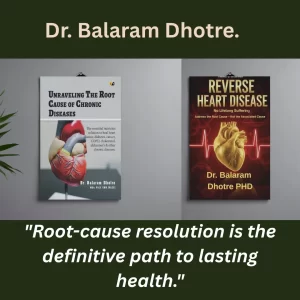
Unraveling the Root Cause of Chronic Diseases
Reverse Heart Disease: No Lifelong Suffering