
Introduction
Here is a disease that was once a death sentence. It is called pernicious anemia.
“Pernicious” means deadly. And for centuries, it was. Patients grew weaker and weaker. Their skin turned pale yellow. Their tongue became smooth and sore. Their hands and feet went numb. They lost their balance. They became confused, depressed, even delusional. Then, slowly, they died.
No one knew why. And no one could stop it.
The Liver Cure That Won a Nobel Prize
In the 1920s, a young American doctor named George Minot became obsessed with blood. He had seen patients with pernicious anemia waste away, and he refused to accept that nothing could be done.
He noticed that his patients often ate very poorly. So he started feeding them large amounts of liver—raw, cooked, even pureed. The results were astonishing. Patients who were near death regained their strength. Their red blood cell counts rose. Their numb hands and feet began to feel again.
Minot and his colleague William Murphy had discovered the first effective treatment for pernicious anemia. In 1934, they won the Nobel Prize.
But they did not know why liver worked. That discovery would take another two decades.
The Discovery That Changed Everything
In 1948, scientists finally isolated the active factor in liver that cured pernicious anemia. They called it vitamin B12 (cobalamin). For the first time, doctors could give pure B12 injections instead of forcing patients to eat pounds of raw liver.
For years, the medical world believed the story was complete. Pernicious anemia was a B12 deficiency. The cause was a lack of “intrinsic factor”—a protein made by the stomach that is needed to absorb B12 from food. Without intrinsic factor, B12 cannot enter the body. The patient becomes deficient. And the deficiency causes anemia and nerve damage.
But that was not the full story.
Why B12 Alone Is Not the Full Story – The Synergy of B12, Folate & Iron
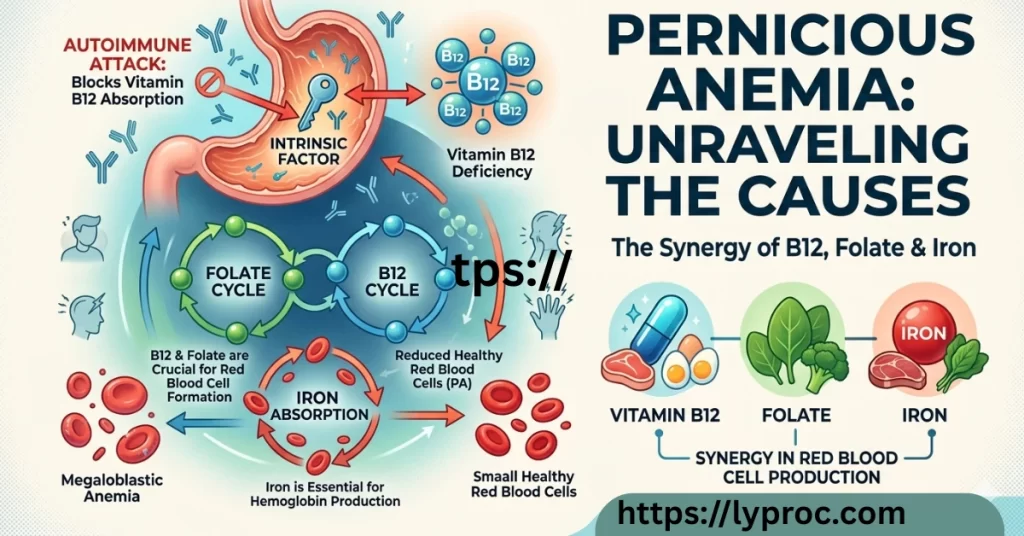
Here is what the textbooks do not tell you. Pernicious anemia is not simply a B12 deficiency. It is a synergistic failure of three essential nutrients that all work together.
Vitamin B12, folate (vitamin B9), and iron are locked in a constant dance inside your body. If one is missing, the others cannot do their jobs properly.
Here is how it works. B12 and folate work together to help your bone marrow produce new red blood cells. They are both essential for DNA synthesis—the genetic code that cells copy when they divide and multiply. Without enough B12 or folate, your bone marrow produces large, immature, fragile red blood cells that cannot carry oxygen properly. This is called megaloblastic anemia.
But even with enough B12 and folate, your body needs iron to complete the job. Iron is the core of the hemoglobin molecule—the protein inside red blood cells that actually carries oxygen. Without enough iron, your red blood cells become small and pale, a condition called iron deficiency anemia.
The three nutrients are not independent. A deficiency in one can mask or worsen the others.
- If you give folic acid alone to a patient with hidden B12 deficiency, the anemia may temporarily improve. But the nerve damage from B12 deficiency continues, sometimes becoming permanent.
- Iron deficiency can “hide” the blood changes of B12 deficiency, making the diagnosis harder.
- A 2023 study of pregnant women found that 7.5% had triple deficiencies of B12, folate, and iron simultaneously.
The Pernicious Anaemia Society reports that up to 40% of patients with pernicious anemia are also iron deficient. They advise testing for B12, folate, and iron together—not separately.
Liver contained all three. That is why it worked so dramatically. It was not a single magic bullet. It was a complete package.
From Pernicious Anemia to Chronic Disease – The Same Pattern
This is where my work begins. In my book Unraveling the Root Cause of Chronic Diseases, I explain that modern chronic diseases—heart disease, diabetes, arthritis—follow the same pattern.
The early deficiency diseases were caused by single nutrient deficiencies. Beriberi was thiamine (B1). Scurvy was vitamin C. Pellagra was niacin (B3). Rickets was vitamin D.
But pernicious anemia taught us something crucial. Even a “classic” single deficiency disease can involve multiple nutrients working together. Liver contained B12, folate, and iron. All three were needed for full recovery.
Today, our diets are not missing just one nutrient. They are missing a combination of dietary factors acting together over decades. Vitamin C, lysine, proline, B vitamins, minerals—all have become scarce in modern processed foods. When multiple nutrients are missing at the same time, the damage happens slowly, over years. That is why we call them “chronic” diseases.
The solution is the same as it was for pernicious anemia. Identify what is missing. Give the body the complete package. Let it heal.
What You Can Do Today
Pernicious anemia was conquered not by a single drug, but by giving the body what it was missing—B12, folate, and iron working together. Heart disease can be approached the same way. Not by lowering numbers with expensive medications, but by giving your body the full range of nutrients it needs to repair itself.
If you want to understand which nutrients are missing from modern diets and how to restore them, read my book Unraveling the Root Cause of Chronic Diseases. I will show you the science and the simple, practical steps.
For more such articles, visit my website: https://lyproc.com
My Books
———————————————————————————————————————————
Links on Amazon
Unraveling The Root Cause of Chronic Diseases:
Reverse Heart Disease: No Lifelong Suffering
———————————————————————————————————————————–