You have probably heard this advice a hundred times: to reverse heart disease, you must eliminate all oils, avoid saturated fats, and eat a strict whole‑food, plant‑based diet with no animal products. You have not heard about artery repair nutrien The logic sounds reasonable—if fat and cholesterol clog your arteries, then removing them from your diet should clear the pipes. Simple.
But ask yourself this: if the advice is so sound, why are millions of people who follow it still getting stents, still taking statins, and still living in fear of a heart attack?
I have asked this question many times. I found that the answer lies not in what these people removed from their diet, but in what was never added in the first place.
Your arteries are not lifeless pipes. They are living, breathing tissues made of collagen—a protein that requires specific nutrients to be built, maintained, and repaired. When you focus only on avoiding oil, you are trying to stop the damage. But stopping damage is not the same as repairing the wall. True healing requires you to actively supply the building blocks the artery needs.
And the three building blocks that matter most are vitamin C, lysine, and proline.
Your Artery Wall Is a Collagen Structure—and Collagen Demands Vitamin C
Every blood vessel in your body is lined with a thin layer of cells called the endothelium. Beneath that lies a matrix of collagen fibres that give the vessel its strength and flexibility. This collagen is constantly being broken down and rebuilt—just like the rest of your body, your arteries are under perpetual renovation.
Collagen synthesis depends absolutely on vitamin C. Without vitamin C, the enzymes that knit amino acids together into strong collagen strands cannot function. The result is a weak, fragile artery wall prone to microscopic cracks.
When those cracks appear, your body does exactly what it is designed to do: it rushes to patch the damage. The emergency patching material it uses is a sticky cholesterol‑based particle called lipoprotein(a)—a biological band‑aid. Over time, layer upon layer of these patches form what we call an arterial plaque.
Notice the sequence carefully: the plaque came after the structural weakness. It did not appear because you ate fat; it appeared because your artery wall was failing from a lack of vitamin C. The cholesterol is not the villain. It is a responder to an underlying nutritional deficiency.
This changes everything about how you should approach heart disease.
Lysine and Proline: The Amino Acids That Hold Your Arteries Together
Collagen is not made of vitamin C alone. The actual strands of collagen are composed of amino acids, and two of them are especially critical for arterial health: lysine and proline.
Lysine is an essential amino acid—your body cannot make it, so you must obtain it from food. It forms the cross‑links that give collagen its tensile strength. Without sufficient lysine, the collagen matrix is like a scaffold built with missing bolts.
Proline, together with lysine, makes up a large portion of the collagen structure. It stabilises the triple‑helix shape that gives collagen its unique ability to withstand the constant pressure of blood flow.
Here is something remarkable: lysine has a second, equally important role. Lipoprotein(a), the sticky repair particle, attaches to the artery wall through specific binding sites. Lysine can occupy those same binding sites, acting as a natural shield that prevents further lp(a) deposition. In simple language, lysine not only helps build strong arteries—it also helps stop new plaque from accumulating.
Now think about what a strict plant‑only, oil‑free diet typically provides. It is rich in many vitamins and fibre. But it can be low in the concentrated lysine and proline found in eggs, dairy, and other animal foods. If you eliminate all these foods without a careful plan, you may unintentionally deprive your arteries of the very amino acids they need for repair.
The goal is not to choose between plants and animals. The goal is to provide every essential nutrient your cells require—from whatever source works for you.
Why “Just Avoid Oil” Is an Incomplete Strategy
The advice to avoid oil rests on a valid observation: heating and processing oils can introduce harmful oxidative stress to the endothelium. Protecting the endothelial lining from injury is a good and necessary step. But protection alone does not rebuild what is already damaged.
Imagine you own an old house with cracks in the walls. One approach is to stop parking heavy trucks near the house so the vibration does not make the cracks worse. That is helpful. But if you never mix cement and fill the cracks, the wall remains weak. The next rain, the next tremor, and the crack grows again.
Avoiding oil stops some of the ongoing injury. It does nothing to provide the vitamin C, lysine, and proline the artery needs to actually repair itself. This is why some people on strict plant‑based diets still experience disease progression—the underlying nutritional deficiency was never corrected.
I learned this first‑hand. In 2010, I was diagnosed with two coronary artery blockages above 80%. After an angioplasty on one side, bypass surgery was recommended. I refused. Instead, I researched the true cause of arterial failure and found the connection between vitamin C deficiency, collagen breakdown, and plaque. I formulated a supplement that provided vitamin C, lysine, and proline in therapeutic amounts—what later became the Lypro‑C formula. I took it consistently. Today, at 75, I am medicine‑free, my heart functions well, and I have not seen the inside of a hospital for my heart in over a decade.
I did not heal by eliminating oil. I healed by giving my arteries the nutrients they had been starved of.
The Synergy Principle: No Single Nutrient Works Alone
Your body never uses a single nutrient in isolation. Just as a construction crew needs masons, electricians, plumbers, and tools all working together to build a house, your cells need multiple nutrients working in synergy to complete any repair process.
When your body repairs an artery, vitamin C activates the collagen‑building enzymes, lysine and proline supply the structural material, but the process also requires:
- Magnesium – to stabilise ATP, the energy currency of the cell.
- Zinc – for cell division and new tissue formation.
- Copper – to cross‑link collagen and elastin fibres.
- B‑complex vitamins – as coenzymes in every energy‑transfer step.
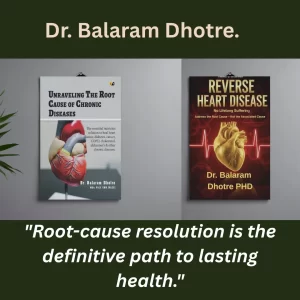
If even one of these is missing, the repair slows or stops. This is the synergy principle I explain in detail in my first book, Unravelling the Root Cause of Chronic Diseases.
This is why a diet focused only on what to avoid—no oil, no fat, no meat—can still leave you deficient in the full spectrum of nutrients required for complete healing. The better question to ask is not “What should I eliminate?” but “What does my body need to function, and am I giving it all of it every day?”
How to Put This Into Practice
If you are serious about reversing heart disease rather than just managing it, your strategy must shift from avoidance to provision. Here are the steps:
- Ensure adequate vitamin C intake daily. This is the non‑negotiable foundation. Rich food sources include amla (Indian gooseberry), guava, citrus fruits, bell peppers, and leafy greens. In many cases, diet alone may not be enough to reverse long‑standing damage, and supplementation becomes necessary.
- Obtain lysine and proline from high‑quality protein sources. Eggs, dairy, fish, and lean meats are concentrated sources. If you prefer plant sources, combine legumes, quinoa, and nuts—but recognise that plant sources are often less dense, and achieving therapeutic levels may require more deliberate planning or supplementation.
- Support the repair process with a full spectrum of minerals and B‑vitamins. Eat a diverse range of vegetables, fruits, whole grains, and healthy protein sources. Avoid the empty calories of sugar, refined flour, and processed foods that deplete your body’s nutrient stores without replenishing them.
- Understand that therapeutic reversal may require doses above the RDA. The Recommended Dietary Allowance is designed to prevent acute deficiency diseases like scurvy, not to reverse decades of accumulated arterial damage. The protocol I developed, the Lypro‑C formula, provides these nutrients in amounts aimed at true repair. You can learn more about the exact protocol in my book Reverse Heart Disease: No Lifelong Suffering.
The Choice Is Yours
The conventional approach to heart disease tells you to spend your life avoiding things—oil, fat, meat, eggs. It is a strategy built on fear and restriction. My approach, rooted in cellular nutrition, tells you to give your body what it needs and let it heal.
Your arteries are living tissue. They have the capacity to repair themselves when you give them the right materials. Vitamin C, lysine, and proline are not exotic compounds; they are the very substances your body has used since birth to build and maintain your blood vessels. A deficiency in any one of them over years is what creates the conditions for disease. Restoring them creates the conditions for healing.
Stop thinking only about what you must remove from your plate. Start thinking about what your arteries have been missing. Supply them, and watch what your body can do.
Give your arteries the nutrients they need, and they will repay you with a lifetime of silent, faithful service.
Written by Dr. Balaram Dhotre, PhD — Medicinal Chemistry (CDRI, Lucknow), with research experience across several pharmaceutical companies in India. His work focuses on explaining the nutrients the body requires, how the body uses them to function optimally, and how their deficiencies are related to chronic diseases. He is the Founder of Lypro-C and author of Unraveling The Root Cause of Chronic Diseases and Reverse Heart Disease: No Lifelong Suffering.
Click here to get your copy of:::::Reverse Heart Disease: No Lifelong Suffering on Amazon
===========================================================================
My Books